
Quick answer
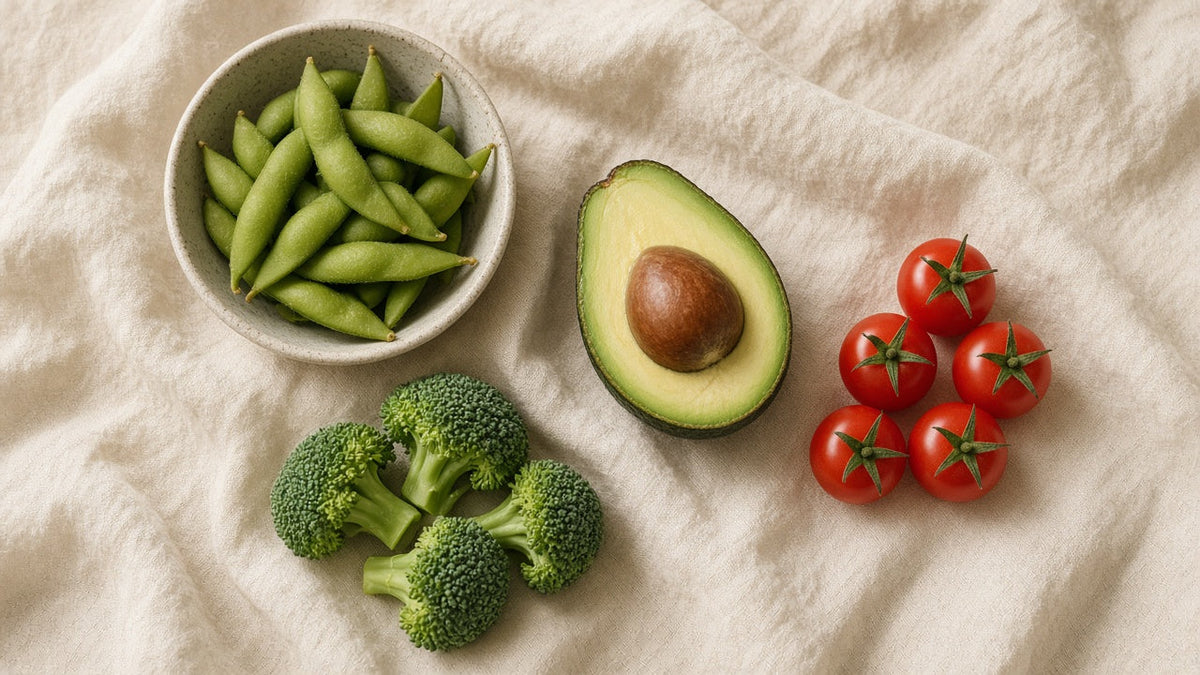
NMN occurs naturally in small amounts in everyday foods. In the only widely cited measurements, edamame, avocado and broccoli contained the most, at up to about 1.9mg per 100g, with smaller amounts in cabbage, cucumber, tomato, mushrooms, raw beef and shrimp (Mills et al., 2016). Your body also makes its own NMN from vitamin B3, and the NMN in supplements is produced commercially and then purified.
NMN, short for nicotinamide mononucleotide, is often described as "found in food", and that is true. What usually gets left out is how little we actually know: how much is in which foods, how reliable those numbers are, and what any of it means for an ordinary British diet. This guide goes through what has been measured, what hasn't, and how NMN gets from a lab or a vegetable into a capsule. If you want the background on NAD+ first, our guide to NAD supplements and what the research shows is a good place to start.
Which foods contain NMN?
The figures quoted almost everywhere online come from one table in a 2016 study that was mainly about NMN in mice. Alongside its main animal work, the team extracted NMN from a range of foods and measured it using HPLC, a standard laboratory method for separating and measuring compounds. Some foods were tested from several sources, which is why many results are ranges rather than single numbers (Mills et al., Cell Metabolism, 2016).
| Food | Type | NMN, mg per 100g |
|---|---|---|
| Edamame (young soybeans) | Vegetable | 0.47 to 1.88 |
| Avocado | Fruit | 0.36 to 1.60 |
| Broccoli | Vegetable | 0.25 to 1.12 |
| Mushroom | Other | 0.00 to 1.01 |
| Cabbage | Vegetable | 0.00 to 0.90 |
| Cucumber peel | Vegetable | 0.65 |
| Cucumber seed | Vegetable | 0.56 |
| Beef (raw) | Meat | 0.06 to 0.42 |
| Tomato | Fruit | 0.26 to 0.30 |
| Shrimp | Seafood | 0.22 |
Source: Table 1 in Mills et al., 2016. Figures are reproduced as published; we have only reordered the rows from highest to lowest.
A few things stand out. Plant foods tended to come out higher than the meat and seafood tested. Two foods, mushroom and cabbage, had at least one sample with no measurable NMN at all. And the spread within single foods is wide: one edamame sample contained roughly four times as much as another. That variation is a useful reminder that a number on a chart is a measurement of particular samples, not a fixed property of a vegetable.
NMN in milk and fermented drinks
NMN has also been measured in milk. A 2017 study developed a method to measure NMN, nicotinamide riboside and NAD+ together in milk from different species (Ummarino et al., Food Chemistry, 2017). A 2023 review of the research on NAD+ precursors in the diet notes that NMN and nicotinamide riboside have been found in vegetables, meat and milk, and that yeasts in fermented drinks such as craft beer can produce them too (Alegre and Pastore, Current Nutrition Reports, 2023).
What these numbers can and can't tell you
It's tempting to turn a table like this into a shopping list. We'd be cautious, for four reasons.
- The evidence base is thin. The 2023 review puts it plainly: only a few studies have measured NMN in foods, and as a result the best sources have not been clearly identified (Alegre and Pastore, 2023).
- Preparation isn't reported for most foods. The table marks beef as raw but doesn't say how the other foods were prepared. We couldn't find good published data on how cooking, storage or freezing changes NMN content, so we won't guess.
- There is no recommended intake. Unlike vitamin B3, NMN has no UK dietary reference value. There's no official figure for how much anyone should eat, from food or anywhere else.
- Presence isn't the same as effect. The authors of the 2016 study suggested that a physiologically relevant amount of NMN might be absorbed from everyday foods (Mills et al., 2016). That was a hypothesis in a mouse paper, not a finding in people, and the 2023 review describes the dietary contribution of NMN as a largely unexplored field of research (Alegre and Pastore, 2023).
How much food would it take to match a supplement?
Purely as an illustration of scale, here is some simple arithmetic using the highest figure in each range. It isn't advice, and nobody should try it.
- Edamame at 1.88mg per 100g: about 16kg to reach 300mg of NMN, or about 27kg to reach 500mg.
- Avocado at 1.60mg per 100g: about 19kg for 300mg, or about 31kg for 500mg.
- Broccoli at 1.12mg per 100g: about 27kg for 300mg, or about 45kg for 500mg.
Why those two amounts? 300mg a day is the dose used in a 60-day, double-blind, placebo-controlled trial of Uthever® NMN in 66 adults aged 40 to 65 (Huang, Frontiers in Aging, 2022). Our capsule, GroovyNMN, contains 500mg. The trial tested 300mg, not 500mg, so it tells us nothing directly about the higher amount, and we don't suggest otherwise. The point of the sums is simply this: the NMN in a normal plate of food is measured in single milligrams, while supplements are measured in hundreds.
None of this makes food less worthwhile. Edamame, broccoli and avocado earn their place on the plate for plenty of reasons that have nothing to do with NMN. It just means "eat more broccoli" and "take an NMN supplement" aren't really interchangeable ideas.
Does your body make its own NMN?
Yes. NMN isn't only something we eat. Our cells make it continuously as part of the way they produce and recycle NAD+, a coenzyme the body relies on. In the main recycling route, often called the salvage pathway, an enzyme called NAMPT turns nicotinamide (a form of vitamin B3) into NMN, and NMN is then converted into NAD+ (Yoshino, Baur and Imai, Cell Metabolism, 2018).
That's why vitamin B3 comes up so often in conversations about NMN. The NHS lists meat, fish, wheat flour and eggs as good sources of niacin, and says most people should be able to get the niacin they need from a varied and balanced diet (NHS, B vitamins and folic acid). The same NHS page notes that high-dose nicotinic acid supplements can cause skin flushing, which is a good illustration of why "more" is not automatically better with any vitamin.
Food also supplies NAD+ itself, along with related compounds. The 2023 review explains that NMN and nicotinamide riboside can reach us in their free form or as products of the digestion of NAD+ in food, which is largely broken down in the small intestine (Alegre and Pastore, 2023).
How is the NMN in supplements made?
NMN in supplements isn't extracted from vegetables; the amounts in food are far too small for that to be practical. Instead, it's produced in one of three broad ways, described in a 2023 scientific review of NMN production (Fermentation, 2023):
- Chemical synthesis. NMN is built up through a series of chemical reactions from starting materials such as nicotinamide and adenosine monophosphate. The review notes that chemical routes tend to have low yields and are less environmentally friendly.
- Enzyme-based production. Purified enzymes are combined in a cascade that converts precursor molecules into NMN, a technique first reported in the 1950s.
- Microbial fermentation. Microorganisms, most often engineered strains of the bacterium E. coli, are grown in bioreactors and produce NMN, which is then separated and purified.
The same review notes that the biological routes, enzymatic and fermentation, generally run under milder conditions and produce fewer unwanted isomers, which are molecules with the same atoms arranged differently. However a manufacturer gets there, the practical question for anyone buying NMN is the same: what is actually in the capsule, and can you see the evidence? That's what a purity test is for.
Food or supplement: how to think about it
The honest answer is that this isn't an either-or decision, and the science doesn't yet give a clear steer. Here is how we'd sum up what's known:
- NMN is present in ordinary foods, but in small amounts that have only been measured in a handful of samples.
- Your body makes NMN itself, using vitamin B3 from a normal diet.
- Supplements contain far more NMN than food, and the human research on NMN supplements is still young. Our NAD supplements guide covers what the studies have and haven't found.
- If you do choose a supplement, the useful questions are about dose, ingredient and testing rather than marketing. Our NMN buyer's checklist sets those out.

Our NMN
Where GroovyNMN fits
GroovyNMN contains 500mg of NMN per capsule, made with Uthever® NMN, and is sold as a food supplement. We publish our latest certificate of analysis on our NMN third-party testing page. For batch NMN250310, an independent third-party laboratory reported NMN at 99.6% by HPLC, along with results for lead, arsenic, cadmium and mercury (certificate of analysis, batch NMN250310 (PDF)). If you'd like to understand every line of it, we've written a plain walk-through: how to read our batch certificate of analysis. You can see GroovyNMN alongside the rest of our range in our Longevity and Focus collection.
View GroovyNMNFrequently asked questions
Which foods contain the most NMN?
In the only widely cited set of food measurements, edamame (young soybeans) had the highest reading, at 0.47 to 1.88mg of NMN per 100g, followed by avocado at 0.36 to 1.60mg and broccoli at 0.25 to 1.12mg. Cabbage, cucumber, tomato, mushroom, raw beef and shrimp also contained small amounts.
How much NMN is in a normal diet?
Nobody knows with any confidence. Only a few studies have measured NMN in food, and the best sources haven't been clearly identified. The measured amounts are small: under 2mg per 100g for every food tested so far.
Does cooking change the NMN in food?
We couldn't find good published data on this. The main food table doesn't report how most of the foods were prepared, so it can't tell us whether cooking, storage or freezing changes the amount of NMN.
Does the body make its own NMN?
Yes. Cells make NMN from nicotinamide, a form of vitamin B3, using an enzyme called NAMPT, and then convert it into NAD+. That recycling route is known as the salvage pathway.
How is NMN for supplements made?
Published reviews describe three broad routes: chemical synthesis, enzyme-based production and microbial fermentation. Biological routes tend to produce fewer unwanted by-products, which is one reason purity testing by HPLC matters.
Which everyday foods provide vitamin B3?
According to the NHS, good sources of niacin (vitamin B3) include meat, fish, wheat flour and eggs. The NHS says most people should be able to get the niacin they need from a varied and balanced diet.
Sources
- Mills KF, Yoshida S, Stein LR, et al. Long-term administration of nicotinamide mononucleotide mitigates age-associated physiological decline in mice. Cell Metabolism. 2016;24(6):795–806. doi:10.1016/j.cmet.2016.09.013.
- Alegre GFS, Pastore GM. NAD+ precursors nicotinamide mononucleotide (NMN) and nicotinamide riboside (NR): potential dietary contribution to health. Current Nutrition Reports. 2023. PMC10240123.
- Ummarino S, Mozzon M, Zamporlini F, et al. Simultaneous quantitation of nicotinamide riboside, nicotinamide mononucleotide and nicotinamide adenine dinucleotide in milk by a novel enzyme-coupled assay. Food Chemistry. 2017;221:161–168. doi:10.1016/j.foodchem.2016.10.032.
- Yoshino J, Baur JA, Imai S. NAD+ intermediates: the biology and therapeutic potential of NMN and NR. Cell Metabolism. 2018;27(3):513–528. doi:10.1016/j.cmet.2017.11.002.
- Biosynthesis of nicotinamide mononucleotide: current metabolic engineering strategies, challenges, and prospects. Fermentation. 2023;9:594. doi:10.3390/fermentation9070594.
- NHS. B vitamins and folic acid. nhs.uk.
- Huang H. A multicentre, randomised, double blind, parallel design, placebo controlled study to evaluate the efficacy and safety of Uthever (NMN supplement), an orally administered supplementation in middle aged and older adults. Frontiers in Aging. 2022;3:851698. ClinicalTrials.gov NCT04228640. doi:10.3389/fragi.2022.851698.
- Groovy Supps. Certificate of analysis, GroovyNMN batch NMN250310, dated 22 July 2025. PDF.


Leave a comment
This site is protected by hCaptcha and the hCaptcha Privacy Policy and Terms of Service apply.