
Quick answer
NMN purity is the share of a tested sample that a laboratory measures as NMN, usually by a method called HPLC. Our latest published certificate of analysis, for GroovyNMN batch NMN250310, reports NMN at 99.6% by HPLC and gives results for lead, arsenic, cadmium and mercury measured by ICP-MS. Below we walk through every line of it, including what it doesn't cover.
A purity figure on a label is a claim. A certificate of analysis is the paperwork behind it. Our NMN buyer's checklist explains briefly what a useful certificate should show. This article goes further and reads one real certificate, ours, line by line, so you can judge it for yourself rather than taking our word for it. You can open the certificate for batch NMN250310 (PDF) alongside this page, or find it on our NMN third-party testing page.
What is a certificate of analysis?
A certificate of analysis (CoA) is a document issued by a laboratory that lists the tests performed on a particular sample and the results obtained. The World Health Organization's model certificate describes the information a good one should carry, including the issuing laboratory, the sample and batch identification, the date the sample was received, the test methods used, the acceptance criteria (limits) and the results (WHO, 2018). That model was written for medicines, not food supplements, but it is a useful yardstick for what to look for on any certificate.
Our certificate was issued by an independent third-party laboratory. It is a single page, titled "Analytical/Chemical Certificate of Analysis".
Reading the top of the certificate
The header identifies what was tested and when. On our certificate:
- Customer: our company name and registered address, showing who commissioned the test.
- Sample name: GROOVYNMN.
- Batch lot number: NMN250310. This is the line to check first. A certificate tells you about the batch it names, so compare it with the batch number printed on your bottle. If they don't match, ask us about it.
- Accession number: 250715-0242, the laboratory's own reference for the sample.
- Received date: 15 July 2025 (written on the certificate in the month/day/year format, 07/15/25).
- Date of the report: prepared and reviewed on 22 July 2025, with the names and signatures of the people who prepared and reviewed it.
The WHO model lists each of these items, from sample identification to the signature of an authorised person, as part of a complete certificate (WHO, 2018).
Line by line: the five results
The body of the certificate is a table with four columns: the test requested, the test method, the specification and the result. Here is what it shows, exactly as reported.
| Test | Method | Specification | Result |
|---|---|---|---|
| NMN | HPLC | >99.5% | 99.6%* |
| Lead | ICP-MS | N/A | 0.015 ppm |
| Arsenic | ICP-MS | N/A | 0.011 ppm |
| Cadmium | ICP-MS | N/A | 0.002 ppm |
| Mercury | ICP-MS | N/A | Not Detected (detection limit 0.000015 ppm) |
The asterisk on the NMN result matters, and we explain it below.
NMN: 99.6% by HPLC
HPLC stands for high-performance liquid chromatography. A dissolved sample is pushed under pressure through a column packed with a material that different compounds cling to by different amounts, so they come out at different times and can be detected and measured separately (Premnath and Zubair, StatPearls, 2024). That separation is what lets a laboratory put a number on how much of a sample is the compound you are interested in, here NMN.
The certificate lists a specification of ">99.5%" for NMN and a result of 99.6%. It does not add a separate "pass" or "conforms" statement, so we won't either. What we can say plainly is that the reported figure is the one written on the certificate, for that batch, from that sample.
The asterisk links to a comment at the foot of the page: this result is not covered under the laboratory's accreditation, and the test was carried out following general compendial methods. "Compendial" means methods published in recognised pharmacopoeias, the reference books of standard tests. In plain terms, the laboratory is telling you that its formal accreditation doesn't extend to this particular NMN test, even though it followed recognised methods. We think you should know that, which is why we're pointing it out.
Lead, arsenic and cadmium: results in ppm by ICP-MS
ICP-MS stands for inductively coupled plasma mass spectrometry. The sample is fed into a very hot plasma that breaks it down into charged atoms, which are then sorted by mass and counted. It is widely used for trace and ultra-trace measurement of many elements at once (Nature Reviews Methods Primers, 2023).
The results are given in ppm, parts per million. By weight, one part per million is the same as one milligram per kilogram (World Meteorological Organization units register), or one microgram per gram. So the certificate reports:
- Lead: 0.015 ppm, or 0.015 milligrams per kilogram of the material tested.
- Arsenic: 0.011 ppm.
- Cadmium: 0.002 ppm.
To put those numbers on a human scale, here is the arithmetic for 500mg of material, the amount of NMN in one GroovyNMN capsule. At 0.015 micrograms per gram, half a gram would contain about 0.0075 micrograms of lead; the same sum gives about 0.0055 micrograms of arsenic and 0.001 micrograms of cadmium. Please treat this as an illustration of scale only. The certificate doesn't say exactly what form the sample took, and it isn't a safety assessment.
Each of these lines has "N/A" in the specification column. In other words, the certificate reports measured amounts but does not state a limit to compare them against, and it doesn't say whether any limit was met. We'd rather show you that honestly than add pass or fail wording the laboratory didn't write.
Mercury: Not Detected
For mercury, the result is "Not Detected", with a detection limit (DL) of 0.000015 ppm. A limit of detection is the smallest amount a given method can reliably tell apart from nothing (IUPAC Recommendations, 2021). So "Not Detected" means no mercury was found above that very low threshold. It is a statement about what the method could see, not a claim of absolute zero.
The small print at the bottom, and why it matters
Three notes at the foot of the certificate are worth reading:
- Accreditation. The laboratory states that it is accredited to ISO/IEC 17025, the international standard for the competence of testing and calibration laboratories. Accreditation to it means an independent body has assessed a laboratory's staff, methods, equipment and quality systems for the specific tests within its scope (UKAS). That accreditation belongs to the laboratory, not to us, and, as above, the certificate says the NMN result sits outside it.
- Representative of the sample. The certificate says its results are representative of the samples submitted and may not be indicative of the entire batch or lot. That is standard, honest wording: a laboratory can only report on what it was sent.
- Methods. Each result gives a method code alongside the technique (HPLC or ICP-MS), so the test can be traced within the laboratory's own procedures.
What this certificate doesn't cover
A certificate is only as useful as you are clear about its limits. This one covers NMN purity and four heavy metals. It does not include:
- A microbiological test. There are no results for bacteria, yeasts or moulds. Microbiological criteria for foods are a separate area of testing altogether (Regulation (EC) No 2073/2005, as it applies in Great Britain), and this certificate doesn't address them.
- Stated limits for the metals. As above, the specification column reads N/A for lead, arsenic, cadmium and mercury.
- Other contaminants. It doesn't report on anything beyond the five tests listed.
- Other batches. It describes a sample from batch NMN250310 only.
- What NMN does. A certificate of analysis is a quality document. It tells you what was measured in a sample. It says nothing about effects in the body, and nor do we.
How to use a certificate when you're choosing NMN
Whichever NMN you are considering, ours or anyone's, the same quick routine works:
- Match the batch. The batch number on the certificate should match the one on the product.
- Check the date. Look at when the sample was received and when the report was signed.
- Find the method. A purity figure should come with a named method, usually HPLC.
- Read the specification column. See whether limits are stated, and for which tests.
- Read the footnotes. Asterisks, accreditation notes and sampling caveats change how a result should be read.
- Notice what's missing. Every certificate has a scope. Knowing what wasn't tested is as useful as knowing what was.
For the wider picture, including dose, ingredients and claims, see our best NMN supplement UK buyer's checklist. If you're curious about how NMN is made in the first place, read where NMN comes from.

Our NMN
Where GroovyNMN fits
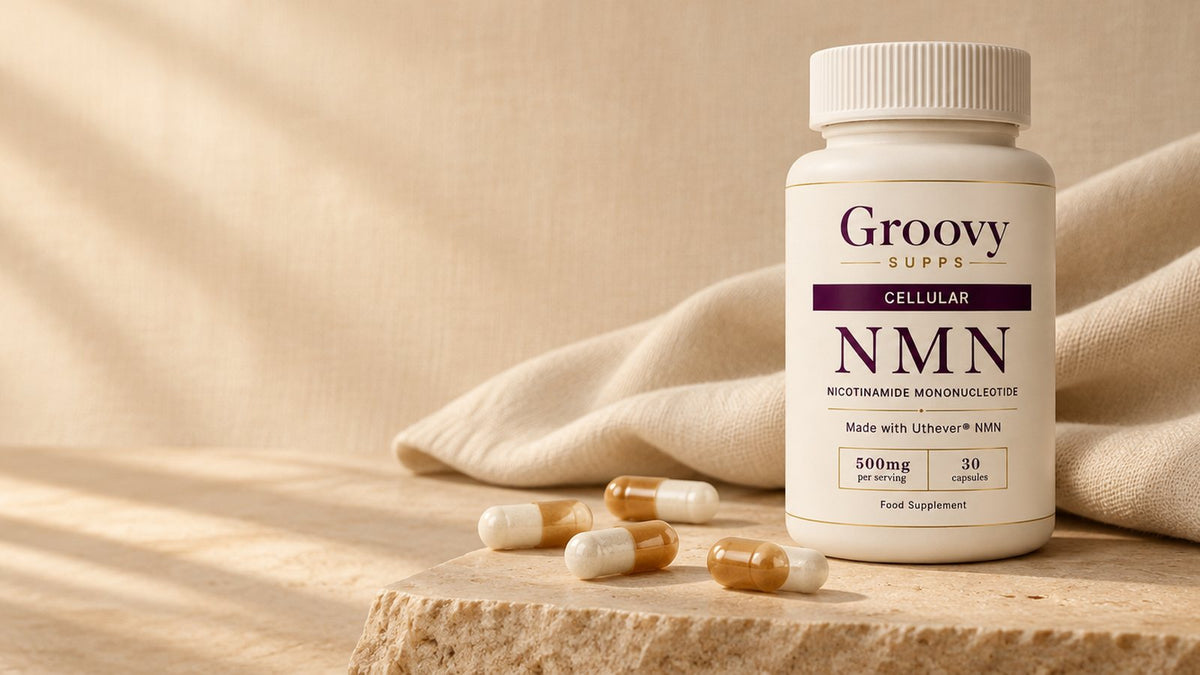
GroovyNMN contains 500mg of NMN per capsule, made with Uthever® NMN, and is sold as a food supplement. We publish our latest certificate of analysis on our third-party testing page so you can read it before you buy, and we'll happily answer questions about it. You can see GroovyNMN alongside the rest of our range in the Longevity and Focus collection.
View GroovyNMNFrequently asked questions
What does 99.6% NMN purity mean?
It means the independent third-party laboratory that tested a sample from batch NMN250310 reported an NMN result of 99.6% using HPLC, a method that separates a sample into its components so each can be measured. The certificate lists a specification of more than 99.5% for this test.
What do HPLC and ICP-MS stand for?
HPLC is high-performance liquid chromatography, used here to measure NMN. ICP-MS is inductively coupled plasma mass spectrometry, used here to measure trace amounts of four metals: lead, arsenic, cadmium and mercury.
What does ppm mean on a certificate of analysis?
Parts per million. By weight, 1 ppm is the same as 1 milligram per kilogram, or 1 microgram per gram. So 0.015 ppm of lead means 0.015 milligrams of lead per kilogram of the material tested.
What does 'Not Detected' mean for mercury?
It means the laboratory did not find mercury above the lowest level its method could reliably detect, which the certificate gives as 0.000015 ppm. It is a statement about the limits of the measurement, not proof of absolute zero.
Does the certificate include a microbiological test?
No. This certificate covers NMN purity and four heavy metals only. It does not include a microbiological test, such as checks for bacteria, yeasts or moulds.
Where can I find the certificate for GroovyNMN?
The latest published certificate, for batch NMN250310, is on our NMN third-party testing page as a PDF you can download and read in full.
Sources
- Groovy Supps. Analytical/Chemical Certificate of Analysis, batch NMN250310, accession 250715-0242, dated 22 July 2025. PDF.
- World Health Organization. Model certificate of analysis. WHO Technical Report Series 1010, Annex 4, 2018. who.int.
- Premnath SM, Zubair M. Chromatography. StatPearls, updated 2024. NCBI Bookshelf.
- Inductively coupled plasma mass spectrometry. Nature Reviews Methods Primers, 2023. nature.com.
- World Meteorological Organization codes registry. Milligram per kilogram (equivalent to ppm). codes.wmo.int.
- IUPAC. Metrological and quality concepts in analytical chemistry (IUPAC Recommendations 2021). Pure and Applied Chemistry. doi.org/10.1515/pac-2019-0819.
- UKAS. Spotlight on accreditation standards: ISO/IEC 17025 for laboratory testing and calibration. ukas.com.
- Commission Regulation (EC) No 2073/2005 on microbiological criteria for foodstuffs. legislation.gov.uk.


Leave a comment
This site is protected by hCaptcha and the hCaptcha Privacy Policy and Terms of Service apply.